
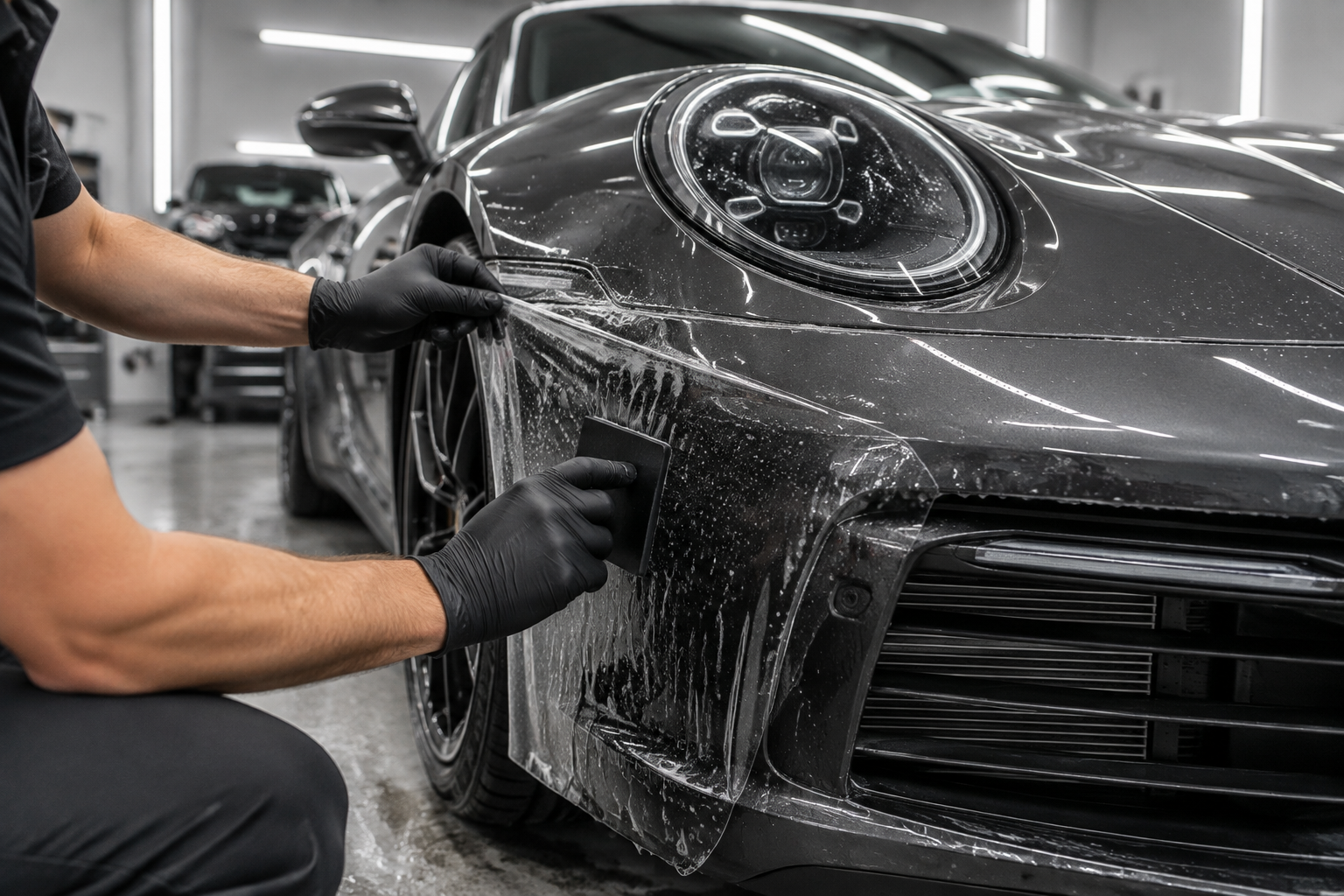
It is the question we hear more than any other at the shop. Someone pulls in with a new car, they have seen PPF all over Instagram, a buddy swears by it, and they want to know if it is worth the money. Great question. Here is the answer from the people who install it every week at our shop in Chatsworth.
Short version: for anyone who wants their paint to stay looking new, and especially anyone putting real freeway miles on their car, yes. Once you know exactly what film protects against, it gets easy to pick the coverage that makes sense for your car and your budget.
What PPF actually is
Paint protection film, sometimes called clear bra, is a clear urethane layer about eight thousandths of an inch thick that gets laid over your factory paint. Good film is optically clear, so a properly installed panel just looks like paint. The top layer has a self healing coat, which means light scratches and wash marks flatten back out with heat from the sun or some warm water.
It is not the same thing as a ceramic coating. A coating is a thin, hard layer that makes paint glossy and easy to clean, but it will not stop a rock. Film is thick enough to take the hit. Plenty of our customers do both: film on the areas that take abuse and a coating over everything.
What it protects against
Rock chips are the big one. Every car on the 118, the 405, and the 5 is throwing gravel at the car behind it, and your front bumper, hood, fenders, and mirrors catch all of it. On bare paint those chips go straight through the clear coat and into the color. With film, the rock hits urethane and the paint underneath never knows it happened.
Sand and road debris are next. Drive the Santa Susana Pass a few times a week or sit behind a gravel truck on Topanga and the leading edge of an unprotected hood slowly gets sandblasted over a year or two. Film takes that wear instead of your paint.
It also handles the everyday stuff. Bird droppings and bug guts that etch clear coat when they bake in the Valley sun, tree sap, hard water spots, a backpack or zipper dragged across a door, and the fine swirls that build up from washing. Door edges and the cups behind the door handles, where rings and fingernails scratch paint, are small spots where film pays for itself fast.
UV matters too. Quality film has inhibitors that slow down the fading and oxidation you see on cars that live outside through a Chatsworth summer.
How to get the most out of your film
The best time to install PPF is while the paint is still in great shape. Film locks in whatever is underneath it, so every PPF job at our shop starts with a paint inspection and, when needed, a paint correction to remove swirls and light defects first. The result is paint that looks better than the day you bought it, sealed under a protective layer.
Coverage is the other piece. Film protects every panel it covers, so the more of the car you wrap, the more of your factory paint stays perfect. That is why so many of our customers go with a full front or full body package. The whole car ages evenly and there are no edges to spot on the hood or fenders.
After that, care is simple. Regular hand washes keep the film clear and glossy, and pairing it with a ceramic coating makes cleaning even easier.
Which coverage makes sense for your car
Most of our customers land on one of three options. A partial front covers the bumper, the first stretch of the hood and fenders, and the mirrors. It is the budget option and it stops the worst of the chips. A full front covers the entire bumper, the full hood, the full fenders, the mirrors, and usually the headlights, so there are no visible edges from the front. Full body covers every painted panel on the car.
For a daily driver that sees freeway miles, full front is the sweet spot for most people. For a car you plan to keep a long time, a color that is hard to match, a matte or satin factory finish, or something you want to sell in perfect shape, full body is where it makes sense. We are always happy to walk around the car with you and point out where it actually takes damage.
Who gets the most value from PPF
New cars are the top of the list. Getting film on before the first road trip means the paint never picks up its first chip. Cars with expensive or hard to match colors, matte and satin factory finishes, and anything you plan to keep for years all benefit in a big way too.
Leased cars are a smart fit as well. Chips and scratches on the front end are one of the most common lease return charges, and film helps you turn the car back in clean.
And if you commute on LA freeways, film pays for itself. Repainting a hood and bumper can cost a good chunk of what a full front install does, and a respray never looks quite like factory paint again. Protecting the original paint also helps resale, since buyers pay more for a car with clean, original paint.
Why the install matters as much as the film
Most of the major film brands carry a ten year manufacturer warranty against yellowing, cracking, and peeling. What that warranty does not cover is a bad install. Lifting edges, stretch marks, trapped dust, and knife cuts in your paint all come down to the person doing the work.
At WRPD we wrap the film around the panel edges by hand wherever the panel allows it, instead of trimming it flat on the paint. It takes longer, but the edges disappear, and they do not collect dirt or start lifting after a few washes. It is the difference between film you forget is there and film you notice every time you walk up to the car.
Want the full details on how we do it? Read more about our Paint Protection Film (PPF) service at WRPD in Chatsworth, serving the greater Los Angeles area.
Common questions
How long does PPF last?+
Quality film lasts around ten years with normal care. Keep it washed, avoid blasting the edges with a pressure washer, and it will outlast most ownership periods.
Can you see paint protection film on the car?+
On a good install you really have to look for it. Gloss film looks like fresh clear coat. We also offer matte film that turns gloss paint into a satin finish if you want a different look.
Does PPF damage the paint when it comes off?+
Not on factory paint in good shape. The film is designed to come off cleanly. Paint from a poor respray can lift with it, which is one more reason we inspect everything first.
How long does a PPF install take at your Chatsworth shop?+
A full front usually takes one to two days depending on the car and how much prep the paint needs. Full body jobs take longer. We give you a real timeline when we quote.
Do you install PPF for people outside Chatsworth?+
All the time. Most of our PPF customers come from around the San Fernando Valley, including Northridge, Porter Ranch, Granada Hills, West Hills, Woodland Hills, and Calabasas, and plenty drive in from across Los Angeles.
Ready to protect your paint? Bring your car by our Chatsworth shop at 9362 Eton Avenue or call (747) 220-0200. We will look at the paint with you, show you where your car takes the most damage, and put together the coverage that fits your car and your budget. WRPD protects cars for drivers from Chatsworth, Northridge, Porter Ranch, and the rest of the greater Los Angeles area.